Planning Your Eating Window Around a Normal Workday
By Brian Hupp ·
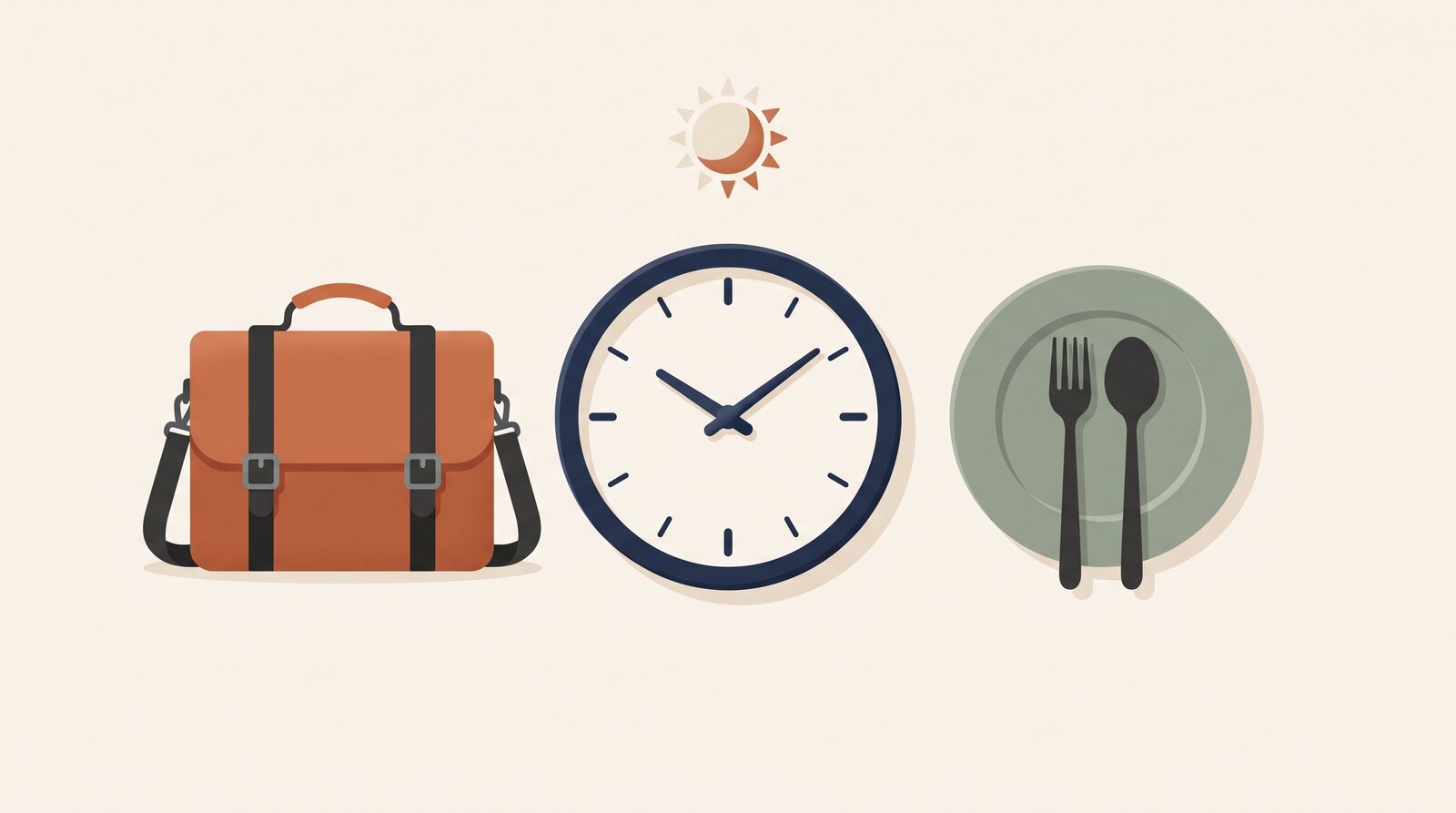
The easiest eating window isn't the one some guide recommends, it's the one that lands on the hours your day already makes easy to eat in. Start from your actual schedule, not a target number, and the window tends to pick itself.
Start with your day, not a protocol
Before picking hours, it helps to answer a few plain questions: when do you actually get hungry? Which meal matters most to you socially, breakfast, lunch, or dinner? When does your schedule make cooking or eating genuinely inconvenient (a long commute, a packed morning, a meeting that always runs through lunch)? The window that survives more than a week is usually the one built around the answers to those questions, not the one copied from somewhere else.
The arithmetic behind the labels
Window labels are just fasting hours plus eating hours adding to 24: 12:12 means 12 fasting hours and a 12-hour eating window, 14:10 means 14 fasting hours and a 10-hour eating window. Nothing about the label dictates when those hours fall; an 8:00 AM to 8:00 PM eating window is a 12:12 day, and a 10:00 AM to 8:00 PM eating window is a 14:10 day. This is clock math, not a recommendation to pick one over the other.
Three worked examples
These are illustrative patterns to show how the logic works, not recommended routines or real case studies. None of them require eating continuously through the whole window, just that meals happen inside it.
Worked example: standard office hours
A 9-to-5 desk job with a lunch break around noon. Eating window noon to 8:00 PM covers lunch and dinner at their usual times and skips breakfast, which some people on this schedule find easier to drop than others; it depends on whether you're hungry early.
Worked example: early riser who dislikes late dinners
Up at 6:00 AM, done with the workday by early afternoon. Eating window 8:00 AM to 2:00 PM covers a real breakfast and lunch, and shifts the "no food" hours into the evening instead of the morning, which can suit someone who doesn't want to plan an evening meal.
Worked example: family dinner is non-negotiable
Dinner with the family happens at 6:30 PM most nights, and that meal isn't moving. Eating window 11:30 AM to 7:30 PM keeps dinner exactly where it already is and adds lunch, rather than trying to force the household's one shared meal earlier or later.
What makes a window unrealistic
A few patterns can break a schedule, regardless of the window length: a workout that lands in the middle of the fasting window with no fuel before or after it, a window that excludes the one meal you're not willing to give up, or hours that only work on paper because they assume a commute or a meeting never runs long. Some people adjust workout timing or intensity around their window and some don't; that's a personal and sometimes medical call, not a rule this article can make for you. If a plan only survives a perfect day, it's worth adjusting before you start, not after the third time it fails.
If your schedule changes often
Rotating shifts, inconsistent hours, or a schedule that genuinely varies day to day deserve their own planning, not a one-size version of the examples above; that's outside what a short article like this can responsibly cover; it's worth raising with a clinician directly, especially before applying any fixed eating-window pattern to overnight or rotating work. The free tracker's eating-window field is just a daily planning note either way, you can change it as often as your actual day changes without losing any saved history.
Before you lock in a window
Talk with a healthcare provider before changing your eating pattern, especially if you are pregnant, have a history of an eating disorder, or have diabetes. NIH News in Health states that anyone considering fasting should talk to their doctor first, and that people with certain health conditions or medications should not fast at all. Don't adjust medication dosages yourself, that's a clinician's call, not a scheduling decision.
For the clock math behind these numbers, see 12:12, 14:10, and 16:8: What Do Fasting Windows Actually Mean?, or try your own schedule in the free tracker.
Get my free one-page fasting window cheat sheet: what the numbers mean and what breaks a fast. Confirm your email and the download opens. New fasting posts come by email after that. No spam.
About the author. Brian Hupp is a regular guy from Ohio who lost about 300 pounds with intermittent fasting after a rheumatoid arthritis diagnosis in late 2022. He is not a doctor or a nutritionist. Read his story: How I Lost 300 Pounds With Intermittent Fasting.